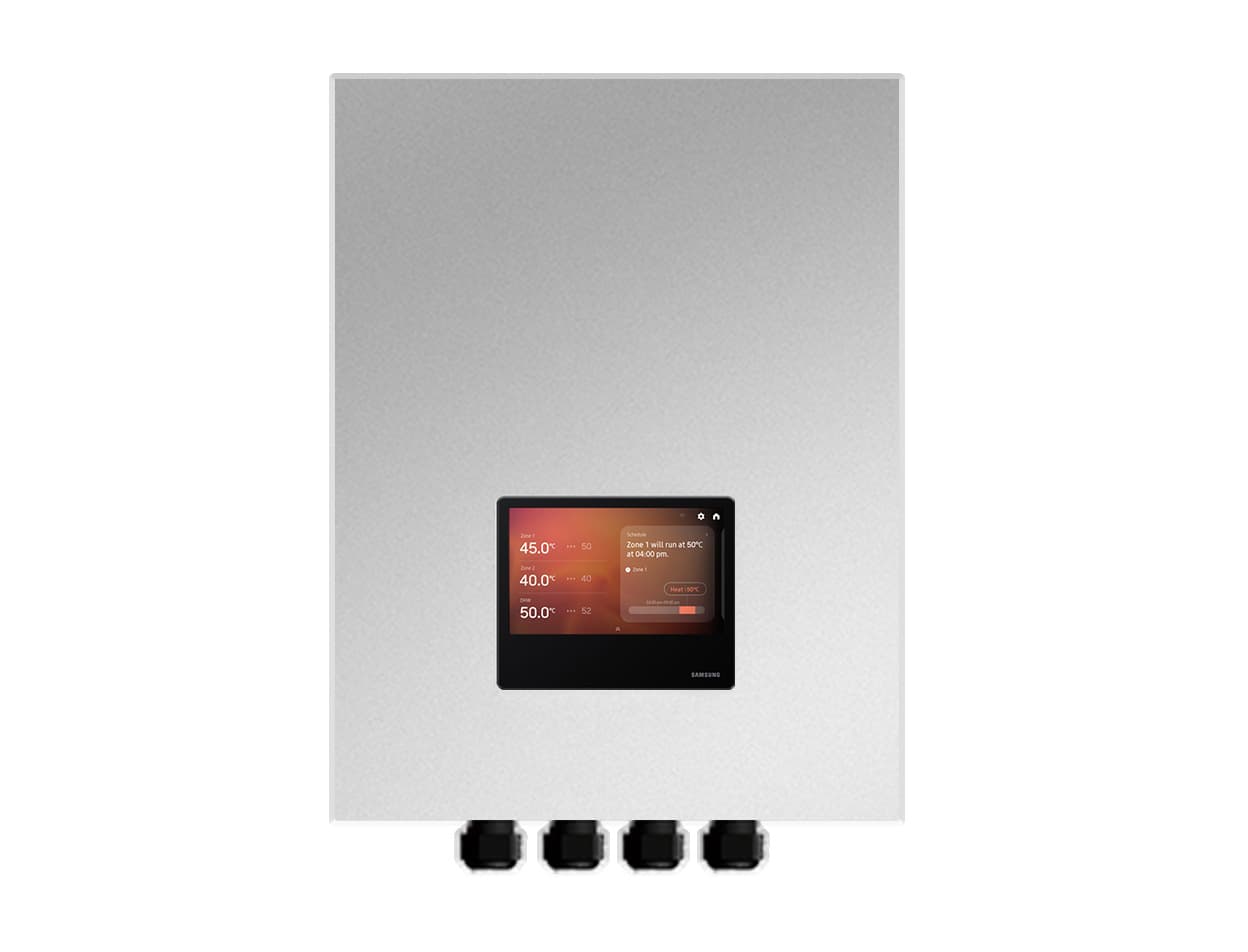
Information about Samsung MCM-D3E0N Cascade Controller
The Samsung MCM-D3E0N cascade controller is designed to manage installations made up of several Samsung EHS Mono air-to-water heat pumps from a single control system. It allows you to connect between 2 and 8 outdoor units and reach a total output of up to 128 kW, offering a solution especially suited to multi-family homes, commercial buildings, collective installations and projects with high heating, cooling and domestic hot water demands.
The controller automatically distributes the thermal demand among the connected heat pumps, operating only the number of units required at any given time. It also incorporates a 7-inch AI Home touch screen, WiFi connectivity, Samsung SmartThings integration, energy monitoring and control of up to two heating zones.
Cascade control for up to 8 Samsung EHS heat pumps
The main function of the Samsung MCM-D3E0N is to coordinate several EHS Mono outdoor units so they work as a single thermal installation.
The system supports a maximum of 8 heat pumps connected to one controller. Samsung allows installations with units of the same capacity as well as combinations of different outputs, provided they belong to the same compatible product type.
With eight 16 kW units, the installation can reach a total capacity of up to 128 kW, making it possible to use Samsung heat pump technology in projects with thermal demands considerably higher than those of a single residential installation.
Automatic management according to thermal demand
The controller continuously analyses the heating, cooling and domestic hot water needs of the installation and adjusts the number of heat pumps that must remain active.
When demand increases, the system can progressively bring more units into operation. When demand decreases, it reduces the number of active heat pumps to avoid running equipment unnecessarily.
This strategy makes it possible to operate with capacity matched to the building’s real demand and to use a multi-heat-pump installation more efficiently.
Operating hour balancing
The Samsung MCM-D3E0N also manages the distribution of operating hours among the outdoor units.
To balance usage, the controller can prioritise starting the unit with the fewest operating hours and stop the one with the highest running time.
This logic helps distribute work across the different heat pumps in the cascade instead of always running the same units.
Continuous operation in the event of a unit fault
A cascade installation also provides greater service continuity. If one of the heat pumps develops a fault, the system can identify the affected unit and continue operating with the remaining available equipment.
In this way, an individual fault does not necessarily mean a complete shutdown of the entire thermal installation, a feature that is especially useful in buildings with permanent heating or DHW requirements.
Heating, cooling and domestic hot water
The cascade controller is designed to manage different thermal needs within a Samsung EHS installation:
- Heating.
- Cooling.
- Domestic hot water (DHW) production.
- Two heating zone control.
This makes it possible to use the same control system in projects that combine climate control and hot water production using several air-to-water heat pumps.
Two heating zones control
The MCM-D3E0N supports the management of two independent zones, making it easier to create installations with different hydraulic circuits or temperature requirements.
The controller can operate zone pumps and mixing valves to coordinate the hydraulic operation of the installation according to the designed scheme.
This capability is especially useful in systems that combine, for example, underfloor heating with other emitters or areas of the building that require different operating conditions.
7-inch AI Home touch screen
The controller incorporates a 7-inch AI Home touch screen that provides a graphical interface for managing and monitoring the installation.
From the screen, it is possible to access operating information, temperatures, operating modes, scheduling and different parameters related to the EHS system.
The interface makes it possible to centralise control of an installation that may consist of several heat pumps and different hydraulic circuits in a single point.
Integrated WiFi and Samsung SmartThings
The MCM-D3E0N includes WiFi connectivity and can be integrated into the Samsung SmartThings ecosystem.
Using a Samsung account and a compatible WiFi connection, the user can register the installation in SmartThings and access connected monitoring and control functions.
Samsung specifies the use of 2.4 GHz WiFi networks for the controller.
Energy consumption monitoring
The system allows you to view information related to the energy consumption of the installation and the connected outdoor units.
Monitoring makes it easier to analyse the operation of the cascade system and check how demand is distributed among the different heat pumps.
With the SmartThings connection, energy display and configuration functions compatible with the installation can also be used.
Time scheduling
The controller allows you to set operating schedules to adapt the system to the building’s timetable and thermal needs.
It is possible to define operating periods and setpoints to reduce unnecessary use of climate control when certain areas or installations do not require service.
Away mode
Its functions include Away mode, designed to maintain heating at a reduced temperature during periods of absence.
This function is useful for maintaining minimum conditions in the building without using the installation with the same comfort settings as during normal occupancy.
Silent mode
The system also features silent mode, allowing the operation of the heat pumps to be adapted when it is necessary to reduce the acoustic impact of the installation.
Its availability and behaviour depend on the connected EHS outdoor units and the configuration carried out during commissioning.
PV and Smart Grid energy management
The controller includes functions related to PV Ready and Smart Grid Ready, allowing thermal production to be integrated into the building’s energy management strategies.
In properly configured installations, the availability of photovoltaic energy or certain external signals can be used to adapt heat pump operation and make more efficient use of the available energy.
Control of pumps, valves and auxiliary components
In addition to managing the outdoor units, the MCM-D3E0N is designed to operate different hydraulic and auxiliary components of an EHS installation.
Depending on the configuration, it can manage or provide control signals for elements such as:
- Primary pumps.
- Secondary pumps.
- Zone circuit pumps.
- 2-way and 3-way valves.
- Mixing valves.
- Backup heater for heating.
- Backup heater for DHW.
- Backup boiler.
- Temperature sensors.
The exact configuration depends on the hydraulic design of the project and must be carried out following Samsung’s specified diagrams and parameters.
Included temperature sensors
The controller is supplied with sensors intended to monitor different temperatures in the hydraulic installation.
Samsung documentation includes sensors for parameters such as tank temperature, water inlet and outlet, and different control points needed to manage the cascade system correctly.
Compatibility with Samsung EHS Mono
The MCM-D3E0N is specifically developed for Samsung EHS Mono heat pump systems.
Samsung specifies its use with different compatible families, including:
- EHS Mono R32.
- EHS Mono HT Quiet.
- EHS Mono R290.
- EHS Mono R290 with integrated pump.
The units connected within the same cascade must belong to the same product type. Different incompatible families must not be mixed within the same cascade.
It is possible to combine different capacities within the same compatible family; for example, units of different outputs from the Mono R290 range.
MIM-E03GN Control Kit depending on the outdoor unit
In certain EHS Mono configurations, it is necessary to install a Samsung MIM-E03GN Control Kit associated with each outdoor unit to enable communication and cascade control.
Samsung indicates that EHS Mono R290 with integrated pump models can operate in the cascade solution without the MIM-E03GN, while other compatible families require the corresponding control kit.
The need for this accessory should always be checked according to the exact reference of the heat pumps selected for the project.
Single-phase power supply
The controller uses a 220-240 V, 50 Hz power supply.
Electrical connection, protection and wiring must be sized and installed in accordance with the Samsung installation manual and applicable regulations.
Samsung MCM-D3E0N dimensions
The controller has net dimensions of 380 mm wide, 480 mm high and 150 mm deep.
Samsung currently specifies a net weight of 7.3 kg. Packaging dimensions are 445 x 605 x 250 mm, with a gross weight of approximately 11.4 kg.
Samsung MCM-D3E0N technical features
- Brand: Samsung.
- Reference: MCM-D3E0N.
- Type: cascade controller for air-to-water heat pump.
- Compatible range: Samsung EHS Mono.
- Number of outdoor units: 2 to 8.
- Maximum system capacity: up to 128 kW.
- Heating: yes.
- Cooling: yes.
- DHW production: yes.
- Two-zone control: yes.
- Automatic cascade unit management: yes.
- Operating hour balancing: yes.
- Partial operation in the event of a unit failure: yes, depending on system configuration.
- Display: AI Home touch.
- Screen size: 7 inches.
- Integrated WiFi: yes.
- SmartThings: compatible.
- WiFi network: 2.4 GHz.
- Energy monitoring: yes.
- Scheduling: yes.
- Away mode: yes.
- Silent mode: yes.
- PV Ready: yes.
- Smart Grid Ready: yes.
- Hydraulic pump control: yes, depending on configuration.
- Valve control: yes, depending on configuration.
- Backup heater control: yes.
- Backup boiler control: available depending on configuration.
- Power supply: 220-240 V / 50 Hz.
- Net dimensions: 380 x 480 x 150 mm.
- Net weight: 7.3 kg.
- Packaging dimensions: 445 x 605 x 250 mm.
- Gross weight: 11.4 kg.
- Color: satin grey.
Centralised control for high-power EHS installations
The Samsung MCM-D3E0N expands the capabilities of EHS Mono heat pumps beyond a single installation, coordinating up to eight units as a single thermal production system.
Its automatic demand management, operating hour balancing, the ability to reach up to 128 kW and control of heating, cooling, DHW and two zones make it a solution especially suited to collective installations and professional projects.
The inclusion of 7-inch AI Home, WiFi, SmartThings, energy monitoring and photovoltaic and Smart Grid integration functions also makes it possible to centralise the operation and energy supervision of a Samsung EHS cascade installation.