Self-Energizing Yellow Fiber Cable Guide 6mm VH600 - 50 Meter Roll
Information about Self-Energizing Yellow Fiber Cable Guide 6mm VH600 - 50 Meter Roll
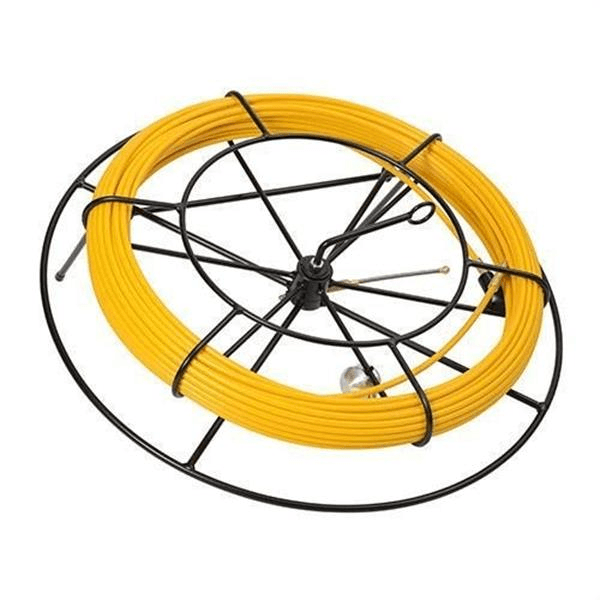
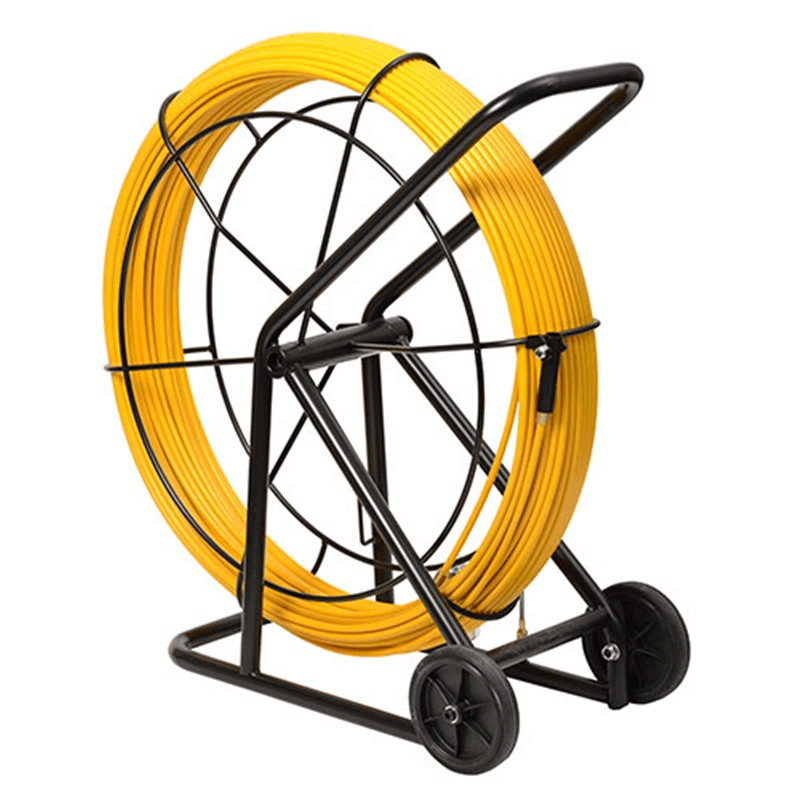
The Estiare self-energizing fiberglass cable rod VH600, reference 30617050, is an industrial cable pulling rod with 50 meters in length and 6 millimeters in diameter, made from fiberglass rod coated with polypropylene. Its high rigidity and pushing force make it especially suitable for pulling and laying cables in long conduits, mainly in straight runs or routes with few bends.
The rod is supplied housed in a VH600 container that makes it easier to transport, store, and handle during installation work. It includes interchangeable end fittings and a set of accessories consisting of a 30-millimeter aluminum roller, 8-millimeter flexible guide head, and 8-millimeter brass pulling ring, all with M5 connection.
50-meter fiberglass industrial cable pulling rod
Reference 30617050 is part of Estiare's range of medium-diameter industrial cable pulling rods, marketed under the Anguila brand. It is intended for cable pulling work in professional installations where longer runs than those typical of domestic rods are required.
The manufacturer classifies 6-millimeter industrial cable pullers for applications in indoor and outdoor installations, especially in shopping centers, logistics centers, industrial warehouses, and other facilities where pulling distances can be considerable.
Polypropylene-coated fiberglass rod
The rod is built with a fiberglass rod coated with polypropylene. This combination provides high rigidity and pushing capacity, while the outer coating protects the fiberglass and helps it move through the inside of the conduit.
Estiare highlights fiberglass for its great pushing force and low friction on straight runs. As a material with no memory effect, the rod tends to maintain a straight path and efficiently transmits the force applied from the insertion end.
Great pushing force for long runs
Fiberglass is the material in the Estiare range that offers one of the highest pushing capacities. This is especially useful when working in long conduits, where accumulated friction can make it difficult for more flexible materials to advance.
Its high rigidity allows force to be transmitted לאורך the 50 meters of rod, facilitating progress in wide tubes and predominantly straight runs.
High torsion transmission
In addition to pushing force, the fiberglass rod efficiently transmits torsional force לאורך the cable puller. The manufacturer notes that this material does not easily rotate on itself, allowing the movement applied at the end to be transmitted during certain guiding maneuvers.
6-millimeter diameter
The rod has an outer diameter of 6 millimeters, corresponding to Estiare's medium-diameter industrial range.
- Rod diameter: 6 millimeters.
- Length: 50 meters.
- Material: fiberglass.
- Coating: polypropylene.
- Color: yellow.
For medium-diameter conduits
Estiare recommends its 6-millimeter industrial cable pullers for conduits of approximately 40 to 140 millimeters in diameter.
The final choice should be made taking into account both the tube diameter and its length, number of bends, internal occupancy, and route difficulty.
Turning diameter of approximately 15 centimeters
According to the manufacturer's technical information for 6-millimeter fiberglass rods, this material has a turning diameter of approximately 15 centimeters.
Its behavior is especially suited to straight sections. Fiberglass is a rigid material and excessively tight bend radii should be avoided.
VH600 container included
Reference 30617050 is supplied with the VH600 container, designed to store and handle the rod during installation work.
The container keeps the 50-meter rod organized and makes both deployment and recovery easier once the cable run is completed.
This configuration is especially practical for long rods, as it helps control the cable puller during transport, storage, and use.
Interchangeable M5 end fittings
The rod features interchangeable end fittings, allowing different accessories to be mounted depending on the stage of the job.
The system uses an M5 connection, compatible with the corresponding accessories in the professional Estiare/Anguila range.
Included accessories
The official catalog identifies the C + D + E accessory set for this reference:
- 1 30-millimeter aluminum roller, M5, reference 4.2001.000.
- 1 8-millimeter flexible guide head, M5, reference 4.1002.000.
- 1 8-millimeter brass pulling ring, M5, reference 4.3002.000.
These accessories allow the rod to be configured both to help it enter the conduit and to hook and pull the cables afterward.
8-millimeter flexible guide head
The included flexible guide head has a diameter of 8 millimeters and M5 connection. Its function is to facilitate the advance of the rod through the conduit and help overcome direction changes within the admissible limits for the rod.
30-millimeter aluminum roller
The kit includes a 30-millimeter aluminum roller with M5 connection, designed as an accessory to help the rod pass through.
Brass pulling ring
For the pulling phase, an 8-millimeter brass pulling ring with M5 connection is included. It allows the end of the cable puller to be connected to the cable or pulling element using the appropriate system.
Set weight of 7.35 kilograms
Estiare's official catalog specifies a weight of 7.35 kilograms for the 6-millimeter, 50-meter version with VH600 container.
This weight corresponds to the set configured with container and provides a useful reference for transport, storage, and handling on site.
Especially suitable for straight runs
Due to the mechanical characteristics of fiberglass, this rod is especially effective in straight runs and conduits where high pushing force is required.
The low memory effect and rigidity of the rod help minimize the friction that can be generated when a more flexible rod takes on winding shapes inside the tube.
Professional use in indoor and outdoor installations
The 6-millimeter industrial range is intended for professional cable pulling work in installations such as:
- Industrial warehouses.
- Logistics centers.
- Shopping centers.
- Large-scale electrical installations.
- Indoor and outdoor conduits.
- Telecommunications and cabling networks.
- Renovation and expansion works.
Precautions during use
Fiberglass provides high rigidity and pushing force, but it is also a material that must be handled correctly. Estiare warns that it can be damaged if loops, kinks, or excessive bends are formed.
During insertion and recovery of the rod, it is recommended to maintain wide turning radii and avoid forcing the rod when it encounters a significant obstruction.
If the cable puller meets abnormal resistance, the cause should be located before continuing to push in order to avoid damaging the fiberglass.
Advantages of the Estiare VH600 fiberglass cable puller
- 50 meters in length for considerable conduit runs.
- 6 millimeters in diameter for industrial use.
- Fiberglass coated with polypropylene.
- High pushing force on straight runs.
- Low memory effect.
- Good torsion transmission.
- Interchangeable M5 end fittings.
- VH600 container included.
- Three accessories included for cable pulling and routing.
- Yellow color for quick identification.
Technical features of the Estiare 30617050
- Brand: Estiare / Anguila.
- Reference: 30617050.
- Type: industrial cable pulling rod.
- Rod material: fiberglass.
- Coating: polypropylene.
- Diameter: 6 millimeters.
- Length: 50 meters.
- Color: yellow.
- Container: VH600.
- End fittings: interchangeable.
- Accessory thread: M5.
- Set weight: 7.35 kilograms.
- Turning diameter indicated for 6-millimeter fiberglass: approximately 15 centimeters.
- Recommended conduits for the range: approximately 40 to 140 millimeters.
- Included accessory 1: 30-millimeter aluminum roller.
- Included accessory 2: 8-millimeter flexible guide head.
- Included accessory 3: 8-millimeter brass pulling ring.
Fiberglass cable puller for long and demanding runs
The Estiare 30617050 VH600 50-meter is a solution especially aimed at professionals who need a rigid rod with high pushing capacity and designed for cable pulling work in long conduits. Its 6-millimeter fiberglass rod coated with polypropylene is optimized to reduce friction on straight runs and efficiently transmit the effort applied from the end of the rod.
Supply with VH600 container, interchangeable end fittings, and three M5 accessories provides a complete set for both inserting the rod and subsequently pulling the cable, keeping the 50 meters of rod organized and protected during transport and daily work.